What is Plastic Jar?
Plastic jar are containers made exclusively or partially of plastic. Plastic containers are ubiquitous either as single-use or reuseable/durable plastic cups, plastic bottles, plastic bags, foam food containers, tupperware, plastic tubes, clamshells, cosmetic containers, up to intermediate bulk containers and various types of containers made of corrugated plastic. The entire packaging industry heavily depends on plastic containers or containers with some plastic content , besides paperboard and other materials. Food storage nowadays relies mainly on plastic food storage containers.
Advantages of Plastic Jar
Low Production Cost
Plastic jar are easy to form and require less energy to produce than metal and glass containers. Plastics are easily shaped when heated, requiring only a moderate amount of pressure. Plastics can even be formed by compressed air. The temperature of its melted state is not as high as metals and glass. Plastics in this state can be injected and molded without the need for expensive dies and tools.
Recyclability
Like glass and metals, plastic jar can be recycled. Traditionally, plastics are recycled through heating and melting. By heating, plastics are melted and formed into raw materials for manufacturing new plastic products. However, melting is only applicable to thermoplastics. Advanced processes are also being developed; generally, these methods chemically convert plastics into monomers that are used as fuels for power generation.
Long Service Life
Because of their chemical and wear resistance, plastic jar do not degrade easily under normal conditions. This gives them a long service life. Some plastic additives further enhance their durability by imparting resistance to oxidation and ultraviolet radiation.
Good Aesthetics And Surface Characteristics
The appearance of plastic jar is fully customizable. Plastic containers can be made into clear, translucent, or fully opaque products. They can also have different colors by adding pigments. When it comes to surface characteristics, plastics can have a variety of finishes and textures without using expensive secondary operations.


Why Choose Us
Our Product
We are a company specializing in the production of all kinds of plastic products, with a wide range of products, involved in health care category, cosmetics, medical supplies, daily necessities, chemical industry, metal and other major categories.
Our Factory
Our company has always been "quality first, customer first, openness basing on sincerity, considerate service" for the purpose of establishing long-term strategic partnership with customers. We can send free samples to customers for testing, but also can produce products according to customers' design drawings or samples, and strictly control the quality of products in every production link.
Our Service
We direct to the consumer, no intermediary sellers, to provide customers with simple, direct and effective supply. We can give every customer the perfect quality, good price and simple and fast transportation, we always take the customer as their own responsibility, to provide customers with better, more assured products.
Our Certifications
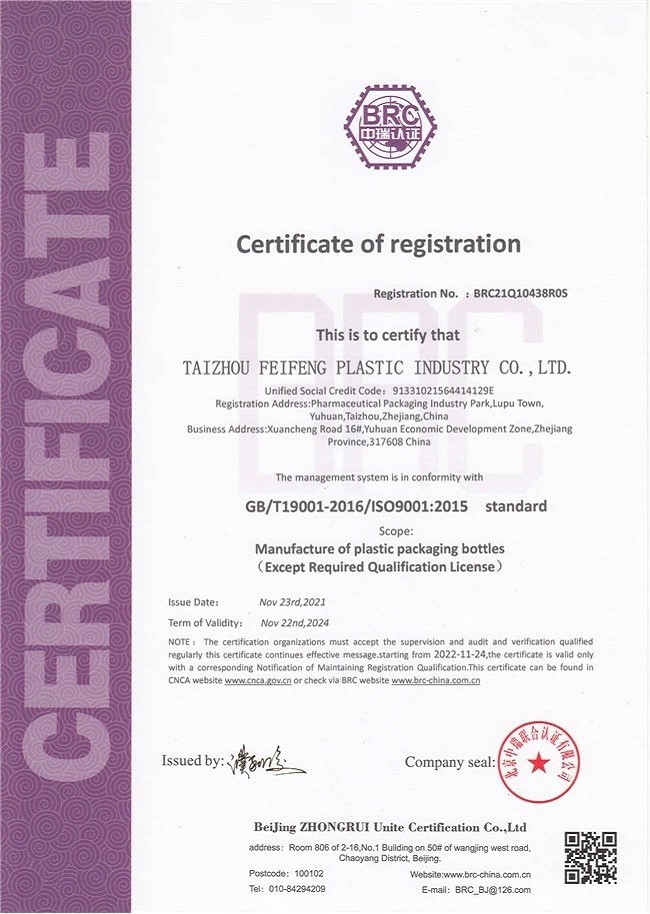
Our company has iso9001, food plastic packaging production license, other certificates are in the process of application, to give you a safe and assured product, welcome to consult and understand.
Polyethylene Terephthalate (pet)
Pet is the most used plastic material for plastic containers. It is known for its low permeability to carbon dioxide, particularly the biaxially oriented types, which makes it ideal for producing bottles for carbonated beverages. Since it absorbs water from its surroundings, it can be processed using molding machines and dried.
High-density Polyethylene (hdpe)
Hdpe is a type of polyethylene (pe). It is characterized as having a high strength-to-density ratio. Its molecular structure is linear, with little branching that results in higher intermolecular forces. Hdpe is commonly used for making stiffer containers and bottles. Examples are water gallons, milk jugs, detergent bottles, and plastic drums. Hdpe can both be reused and recycled. It is considered one of the safest forms of plastics.
Polyvinyl Chloride (pvc)
Polyvinyl chloride is a type of plastic that can be formulated with different stabilizers, plasticizers, impact modifiers, processing aids, and other additives. It can be made into rigid or flexible plastic containers by modifying the amount of plasticizers. Moreover, they offer better clarity than other versatile plastics. However, pvcs have the potential to release harmful pollutants, acids, and toxins during processing or degradation. Its compounding ingredients are now being regulated by the fda, epa, and other organizations.
Low-density Polyethylene (ldpe)
Low-density polyethylene is another type of pe. It has a branched polymer chain linked by weak intermolecular forces. This results in lower tensile strength and barrier properties. Nevertheless, it has better impact strength and resilience than hdpe. They are used for making flexible containers and bottles such as squeezable bottles, dispensing bottles, and sampling containers.
Polypropylene (pp)
Polypropylene is a versatile polymer that can have a wide range of properties. Its properties depend on its molecular weight, morphology, crystalline structure, additives, and copolymerization. It can be made into polymers with a high degree of crystallinity. This results in higher tensile strength and hardness comparable to hdpe. Moreover, they can withstand high temperatures without losing strength or undergoing degradation. The disadvantages of using pp are its susceptibility to uv degradation and oxidation. Pp is commonly used for producing drums and pails.
Polystyrene (ps)
Similar to polypropylene, polystyrene is another versatile plastic modified by copolymerization and the addition of additives. They can be made into flexible, rigid, or cellular (foam) plastic forms. Polystyrene is generally prone to oxidation; thus, repeated recycling is not recommended. Furthermore, their sensitivity to oxidation causes their color to become yellowish. Ps is often used for making disposable containers, such as clamshell food packaging and disposable cups.
Polycarbonate (pc)
Polycarbonate is easily processed by different molding methods, with injection molding and sheet extrusion being the most common. Its usual applications are beverage bottles and food storage containers. Polycarbonates are known for their high impact strength, heat resistance, good electrical insulation, transparency, good water barrier properties, and inherent flame-retardant properties.
Acrylonitrile Butadiene Styrene (abs)
Acrylonitrile butadiene styrene is a common plastic material characterized by good hardness and rigidity while having some degree of toughness. Protective coatings are usually applied due to their poor resistance to uv and only adequate resistance to most acids and alkalis. They are commonly used for making battery containers.
Nylon Or Polyamide (pa)
Polyamide is considered an engineering plastic characterized by its high toughness, high impact strength, resistance to solvents, good abrasion resistance, and heat resistance. The common application of pa is automotive fuel tanks.
The Production Process of Plastic Jar


Treatment Of Plastics
Because plastic jar macromolecule contains fat base, it has a certain degree of hydrophilicity. The pellets are more sensitive to water at high temperature. When the moisture content exceeds the limit, the molecular weight of plastic jar will decrease during processing, and the product will become colored and change. Brittle. Because of this, the materials must be dried before processing. The drying temperature is 150°c for more than 4 hours, generally 170°c for 3-4 hours. The air shot method can be used to check whether the material is completely dry. When using materials, the raw materials should be dried to a certain extent, and different drying temperatures and time limits should be paid attention to to ensure that the plastic jar produced have good product functions.
Selection Of Injection Molding Machine
Because the plastic jar has a short period of time after the melting point and high melting point, it is necessary to choose an injection system with more temperature control sections and less self-friction heat generation during plasticization, and the actual weight of the product cannot be less than 2/3 of the injection volume of the machine.
Detention Time
Do not use an excessively long residence time to prevent the molecular weight from decreasing. Try to avoid temperatures above 300°c. If the downtime is less than 15 minutes. Only need to do air injection treatment; if it exceeds 15 minutes, clean with viscosity pe, and reduce the barrel temperature to pe temperature until it is turned on again. Strict control should be carried out on the residence time of plastic jar. Different temperatures need to be processed differently, so the time limit should be strictly controlled.
Matters Needing Attention
The recycled material should not be too large, otherwise it is easy to cause “bridging” at the unloading place and affect plasticization. When recycling plastics, strictly control the number of recycled materials to ensure the plasticization quality of plastics. If the mold temperature is not well controlled or the material temperature is not properly controlled, it is easy to produce “white fog” and opacity. Strictly control the mold temperature, otherwise there will be undesirable events. The mold temperature is low and average, the cooling rate is fast, and the product is transparent with less crystallization.
Mold And Gate Design
Plastic jar are generally formed by hot runner molds. It is better to have a heat shield between the mold and the injection molding machine template, the thickness of which is about 12mm, and the heat shield must be able to withstand high pressure. The exhaust must be sufficient to avoid local overheating or chipping, but the depth of the exhaust port should generally not exceed 0.03mm, otherwise flash will easily occur. The production process of plastic jar requires strict quality system maintenance to ensure that the produced plastic bottles have good product quality and guarantee. The production process is complicated, and different production processes need to be strictly controlled to ensure that each process is carried out in strict accordance with the standards.
How to Choose Plastic Jar
In every corner of life, almost all of the plastic cans of the figure - drink the cup, eat with the bowl, plate, there are a variety of plastic cans bags, plastic wrap, and so on. There is a careful view of the audience found that some plastic cans at the bottom of a sign: A triangle with a triangle, there is a triangle inside the figure - why the plastic tank to print this logo, the logo inside the number of what it means , how to use plastic pot is safe?
Triangle represents recyclable, and digital represents material. There are many types of plastic cans, there are more than 100 kinds of this logo is like a small identity of each plastic tank containers, their production of different materials, the use of different.
The plastic cans marked with numbers 1 to 6 are often used for packing or containing food. Numbers 1 often appear in a variety of mineral water bottles, drink bottles; the number 2 common in the supermarket shopping bags, food bags. Numbers 3 and 4 can be found on some cling films; the plastic hoods marked with numbers 5 are more common and can be seen in plastic boxes and boxes that can be heated in a microwave oven, and some plastic jars will see this logo; on some disposable cups.
Compared with the plastic pot marked 6, marked 5 of the polypropylene plastic cans, which contain less additives, more stable at high temperatures. If it is to use boiling water, then, in order to reduce the precipitation of harmful substances, or with a sign of 5, soft plastic cups more secure.
Mark 6 plastic cups can be filled with cold drinks, do not use tea, and can not be loaded with strong or strong alkaline substances, such as orange juice, because in this condition, it will break down on the human body harmful poly styrene.
Marked as 5 plastic jar called polypropylene, this product can be resistant to 130 ℃ high temperature, can be placed in the microwave heating high temperature, many plastic jar are made of this material box. But with such a hot lunch hot dishes is not it can sit back and relax it?
Put a certain amount of edible oil into the plastic pot lunch box, and then cover the lid, into the microwave heating high temperature, the temperature of 110 degrees celsius, the plastic tank lunch box all normal, the oil temperature reaches 140 degrees celsius, the lunch box has soften. Plastic jar become soft, indicating that some of the harmful substances inside the material has begun to melt into the oil.
Obviously can be written into the microwave heating box how to become soft melting it? The reason is that edible oil in the case of microwave heating, the oil temperature can reach nearly 200 degrees celsius. And the greater the amount of oil, the faster the temperature rise. So like boiled fish, braised eggplant like oil leftovers, do not use plastic cans lunch boxes in the microwave heating. When heating other dishes, it is important to note that when heating the lid to open, the heating time should not be too long to avoid the oil temperature is too high, harmful substances precipitation.
How to Clean Plastic Jar
Bleach For Coffee And Tea
For liquid stains that need a powerful cleanup, use a mild bleach solution made from 1 tbs. Chlorine bleach mixed with 1 cup hot water. Let the stained plastic container soak for 40-45 minutes, then discard the bleach solution. Thoroughly wash the container in hot, soapy water and let it air dry.
Hand Sanitizer On Food Dyes
We all have containers with the tell-tale red ring! This type of stain comes from tomato-based sauces.
Turns out that liquid alcohol-based hand sanitizers work wonders on this type of stain. Pour enough liquid hand sanitizer into the container to cover the stain area, letting it sit for 45 minutes. Pour out the hand sanitizer, then use a soft cloth to wipe away the stain. Wash the container with hot soapy water and air dry.
Baking Soda
Baking soda is a natural ingredient that’s gently abrasive, helping loosen stains and odors. Add a couple tablespoons of baking soda to the plastic container, then just enough warm water to form a paste. Spread the paste over the bottom and sides of the container and let it sit for 30 minutes. Rinse the paste away, then wipe down the container with a soft cloth. Wash with hot soapy water and air dry.
Newspaper For Lingering Odors
If baking soda removed the stain but not the food odors, crumple some newspaper and gently pack it into the container then seal with the lid. Let the container sit for 1-2 days then discard the newspaper and wash the container with hot soapy water.
Try A Sugar Scrub
To use sugar enzymes and ice to break down stains, add 1/4 cup granulated sugar to the stained container. Drizzle the sugar with a bit of dish soap, then cover with five to six ice cubes and let sit one hour. Pour the contents from the container, using the remaining sugar as an exfoliant on stains to loosen them from the plastic. Rinse with hot soapy water and air dry.
Let The Sunshine In
Pair the acid from a lemon with the sun’s uv rays to fade stains and kill bacteria on plastic containers. Cut a lemon in half and rub it along the discolored areas of the container. Squeeze the remaining juice from the lemon into the container. Place the container in a sunny location for a day or two to let the magic happen. Wash with hot soapy water to remove stains, then air dry.
Certifications