What is Plastic Bottle?
A plastic bottle is a bottle constructed from high-density or low density plastic. Plastic bottles are typically used to store liquids such as water, soft drinks, motor oil, cooking oil, medicine, shampoo, milk, ink, etc. They come in a range of sizes, from very small bottles to large carboys. Consumer blow molded containers often have integral handles or are shaped to facilitate grasping.
Advantages of Plastic Bottle
Tough And Secure
Unlike glass containers, plastic bottles are robust and sturdy. When dropped, they do not shatter into sharp fragments. This makes products and packaging safe to handle. Plastics have important physical features such as toughness and chemical resistance because they are polymers. Bottles and containers made from plastic are impervious to leaks and bursts, preserving both the contents and the outer transportation containers.
Savings On Energy
Plastic bottles are lighter than glass bottles, which saves energy and money when shipping products. Plastic bottles require less energy to produce than glass bottles because plastics are soft and have relatively low melting temperatures.
Colors And Shapes
Plastic products are easy to shape into a variety of bottle forms, which improves their appearance and usefulness. Some varieties of plastic bottles, for example, include inbuilt handles, measuring indications, and pouring lips. Furthermore, plastics can range from clear to any shade or color, whether translucent or opaque. This makes products and branding easily identifiable by sight.
Reusable Material
Pet, including other bottle material types, are easily recycled after their initial usage. They can be remade into a variety of secondary goods. Some beverage bottles and nonfood containers are also made from recycled plastic. Plastic bottles' small weight reduces the cost of transporting recyclables to recycling centers.


Why Choose Us
Our Product
We are a company specializing in the production of all kinds of plastic products, with a wide range of products, involved in health care category, cosmetics, medical supplies, daily necessities, chemical industry, metal and other major categories.
Our Factory
Our company has always been "quality first, customer first, openness basing on sincerity, considerate service" for the purpose of establishing long-term strategic partnership with customers. We can send free samples to customers for testing, but also can produce products according to customers' design drawings or samples, and strictly control the quality of products in every production link.
Our Service
We direct to the consumer, no intermediary sellers, to provide customers with simple, direct and effective supply. We can give every customer the perfect quality, good price and simple and fast transportation, we always take the customer as their own responsibility, to provide customers with better, more assured products.
Our Certifications
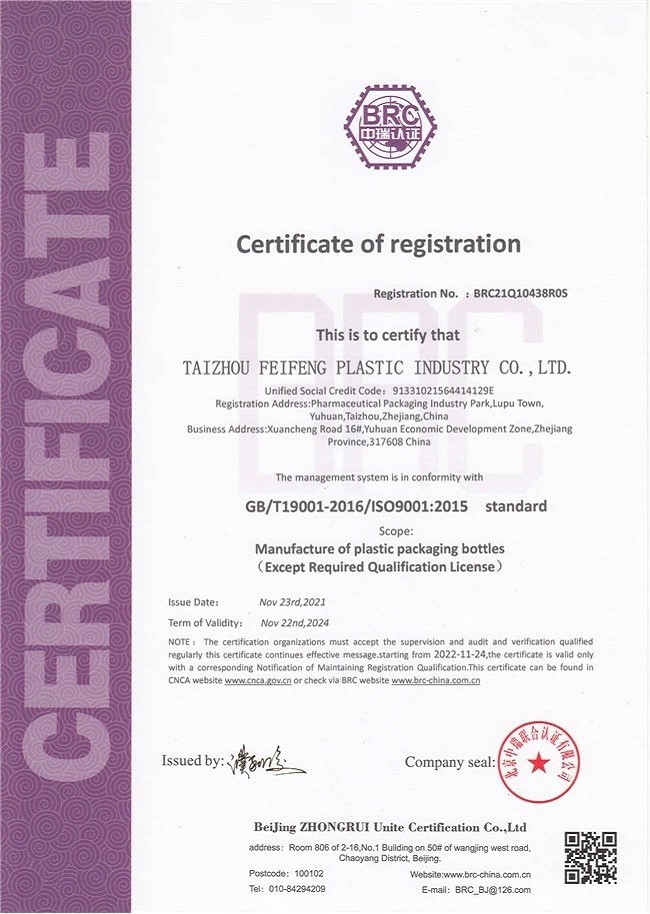
Our company has iso9001, food plastic packaging production license, other certificates are in the process of application, to give you a safe and assured product, welcome to consult and understand.
What Are The Raw Materials Of Plastic Bottles
Polyethylene terephthalate
“A plastic bottle made of polyethylene terephthalate has the resin identification code 1. Also known as pet, pete or polyester, it is often used for carbonated beverages, water and food products because it is strong and light. Like most plastics, pet is made from petroleum hydrocarbons, formed as a reaction between ethylene glycol, a colorless viscous hygroscopic liquid, and terephthalic acid, an organic compound. During the production process, pet polymerizes to form long molecular chains.
High-density polyethylene
“The resin identification code 2 denotes high-density polyethylene (hdpe). It is economical and yields an efficient moisture barrier, making it the most widely used material for plastic bottles. It is made from petroleum, a naturally occurring liquid found in geological formations beneath the earth’s surface. Hdpe is resistant to many solvents and has a high density-to-strength ratio, making it the ideal plastic for reusable and recyclable bottles. It is also used to make pipes, lumber, fireworks and plastic bags.
Low-density polyethylene
“Low-density polyethylene (ldpe) has a similar makeup to hdpe but is more translucent, less chemically resistant and less rigid. Ldpe, which has the resin identification code 4, is made from the monomer ethylene and is most commonly used to make plastic bags, but it can also be found in detergent bottles, dispensing bottles, and squeezable bottles for foodstuffs like honey and mustard.
Polystyrene
“Polystyrene (ps) is a synthetic aromatic polymer made from the monomer styrene. It may come solid or foamed and has the resin identification code 6. As a rigid plastic with an excellent moisture barrier and low thermal conductivity, ps is often used to make bottles for dry products, such as vitamins and aspirin. Some milk and yogurt drinks may also come in ps bottles.”
The Production Process of Plastic Bottle


Raw Materials
Pet is a plastic resin derived from petroleum hydrocarbons. The producer creates long chains of plastic molecules through a process called polymerization, and then mixes the material with several chemical compounds. They cut the resin into small pellets and send it on to the bottle manufacturer. The bottle plant mixes pet resin pellets with "regrind" -- recycled plastic that has been reduced to flakes. Plastic loses some of its physical properties when repeatedly heated, so manufacturers must limit the amount of regrind they use, typically capping this ingredient at 10% of the total mix. Unless producing clear bottles, dyes are introduced to the mix as well.
Building A Preform
An extruder melts the pet and regrind mix at temperatures of about 500 degrees fahrenheit. A screw inside the extruder compresses the pet mix and injects the nearly molten material into molds. The mold produces a bottle preform, which is sometimes called a parison. The preform looks like a thick-walled test tube, often including the bottle’s characteristic screw top. The preform cools as it travels to a machine called a blow molder, and may need to be brought back up to the manufacturer’s specified temperature for that operation. If necessary, the bottle manufacturer raises the temperature of the preform in a small oven.
Stretching The Preform
The preforms enter a two-part mold that closes around it. The inside of this mold is shaped exactly like the finished bottle. Inside, a long needle pushes up through the preform, which is suspended with the screw end facing downward. The needle stretches the preform upward toward the top of the mold -- which will be the bottom of the bottle -- and simultaneously blasts enough pressurized air into the preform to force it against the sides of the mold. This stretch blow molding process must happen quickly in order to maintain the bottle’s integrity and consistent shape. Some manufacturers weld a separate bottom piece to the bottle during blow molding, while others produce a bottom from the preform along with the rest of the bottle.
Cooling And Trimming
The bottle must be cooled almost instantly or it will lose its shape when gravity causes it to creep downward in its malleable, heated state. Some manufacturers cool the bottle by circulating cold water or liquid nitrogen through the mold, others elect to fill it with a shot of air at room temperature. The mold typically yields a clean bottle, but some flashing may occur at the bottle seams, where the two mold halves met. If so, operators trim away the excess material and add it to the regrind.
Application of Plastic Bottle
Uses For Plastic Bottles: Soothe Achy Feet Fast
You spent the day running errands and now your tootsies are tired and sore. The simple trick doctors recommend to soothe tender feet: Freeze a bottle of water, then roll it under your arches for a minute. Pause for another minute. Repeat for 10 minutes. The cold temperature combined with the rolling motion will ease inflammation and tightness. Aah, that’s better!
Easily Separate An Egg
A foolproof method to separate egg whites for the cake you’re making for the church potluck: Crack an egg into a bowl, then squeeze an empty plastic water bottle over the yolk and release. Squeezing the bottle creates a vacuum effect so the yolk gets sucked up, leaving the whites behind.
Help Boots Hold Their Shape
To keep your tall boots from falling over in your closet, leaving behind an unsightly crease in the material, try this: Before placing the footwear in your closet, slide an empty 1-liter plastic bottle inside each boot. The bottles will help the shoes keep their shape when you’re not wearing them.
Uses For Plastic Bottles: Prevent Dry Foods From Going Stale
Instead of buying pricey storage containers to keep pantry staples like rice and beans fresh, use a recycled plastic water bottle. Simply wash and dry a bottle thoroughly, then use a funnel to fill it with food and screw on the cap. The clear bottle allows you to see what’s inside at a glance, and the cap forms an airtight seal that keeps the ingredients fresh!
Easily Corral Project Tools
When you’re working on a project, it can be a pain to have to lug around a bulky toolbox just for the few tools you need. Instead, stash them in a diy tool tote you can take with you while you work. To do: Cut the top third off of a 2-liter plastic bottle and wrap duct tape around the bottom of the bottle to help reinforce it. Then fill with the tools needed. Problem solved!
Uses For Plastic Bottles: Outsmart Doggy Boredom
Cooler weather mean your active dog has less time out in the yard — and being cooped up lands her in trouble, especially when she chews on things she isn’t supposed to! To keep her occupied indoors, create a fun noisemaking chew toy. To do: Cut the leg off an old pair of jeans, then slide an empty plastic water or soda bottle in the center. Knot the jeans on both ends of the bottle and cut tassels, then toss the toy to your pal. She’ll love the crinkling sound the bottle makes as she chews on it, and the denim is sturdy enough that she won’t chew through the material.
The solid plastic bottle must have the function of bearing external force, it can adapt to a variety of transportation methods and warehouse storage methods, and protect the contents from damage.
The solid plastic bottle makes the product have the display function. The solid plastic bottle can display the display function of the product through beautiful shape, bright color, smooth surface and transparency. Attract customers and stimulate their desire to buy.
Plastic bottles of different colors can clearly indicate the series, type or model of the product. Transparent solid plastic bottles can display the purity of the color and quality of the contents; translucent solid plastic bottles can partially display or conceal the contents; opaque plastics bottles can be canned with items of various colors. The surface printing of solid plastic bottles can transmit the printed information directly to consumers.
The solid plastic bottle should have the function of being easy to use. The bottle mouth design of the solid plastic bottle should consider the convenience of opening, and it can be opened and closed multiple times, and it should be convenient to pour the contents. Sputtering injuries cannot be produced. When designing the product, other functions can be attached to the sealer: Such as anti-counterfeiting, anti-theft, anti-clogging, spraying, etc.
Recycling of Plastic Bottles
There are numerous reasons why plastic bottles should be recycled. For starters, recycling minimizes pollution caused by the chemicals used to manufacture these bottles. Recycling also reduces the amount of rubbish sent into landfills, allowing the garbage to take up less space.
The bulk of the waste is disposed of in landfills. It could need up to 500 years to disintegrate and decompose but could leach pollutants into the water and soil. Around 165 million tons of plastic rubbish lies floating in the oceans, posing a health and safety threat to marine life.
Micro-plastics are minuscule particles smaller than five millimeters in length produced from cosmetics, fabrics, or the breakdown of larger pieces that can be eaten by marine wildlife. They also contribute an additional 8.8 million tons to the oceans each year. Recycling also employs people who collect recyclable items and work in facilities that convert them into new materials. Recycling is important for both the economy and the environment, and it is easy to do.
Certifications