What is Plastic Capsule Bottle?
A plastic capsule bottle is a specialized container designed for housing small, discrete objects or substances, such as pills, capsules, beads, or powders. Comprised of two primary components—a cylindrical outer bottle made from durable plastic and an inner capsule, also typically constructed from plastic—this innovative packaging solution combines the protective qualities of a conventional bottle with the compact, portable nature of a capsule.
Advantages of Plastic Capsule Bottle
Ightweight And Portable
One of the primary advantages of plastic plastic capsule bottle is their lightweight nature. Plastic capsule bottle is significantly lighter than glass, which is a common alternative for pharmaceutical containers. This makes plastic capsule bottle easy to handle, transport, and store, benefiting both patients and healthcare professionals.
Durability And Resistance
Plastic capsule bottle is known for its durability and resistance to breakage. Unlike glass, plastic capsule bottle are less prone to shattering if dropped or subjected to impact. This not only ensures the safety of patients and healthcare workers but also reduces the risk of contamination from broken glass.
Tamper-evident Features
To enhance patient safety and maintain the integrity of pharmaceutical products, many plastic capsule bottle are equipped with tamper-evident features. These features provide visible evidence of tampering, reassuring patients that their medications have not been compromised.
Moisture And Light Resistance
Plastic capsule bottle offers excellent moisture and light resistance, protecting the contents from environmental factors that could degrade the medication's potency. This is crucial for ensuring that pharmaceutical capsules remain effective throughout their shelf life.


Why Choose Us
Our Product
We are a company specializing in the production of all kinds of plastic products, with a wide range of products, involved in health care category, cosmetics, medical supplies, daily necessities, chemical industry, metal and other major categories.
Our Factory
Our company has always been "quality first, customer first, openness basing on sincerity, considerate service" for the purpose of establishing long-term strategic partnership with customers. We can send free samples to customers for testing, but also can produce products according to customers' design drawings or samples, and strictly control the quality of products in every production link.
Our Service
We direct to the consumer, no intermediary sellers, to provide customers with simple, direct and effective supply. We can give every customer the perfect quality, good price and simple and fast transportation, we always take the customer as their own responsibility, to provide customers with better, more assured products.
Our Certifications
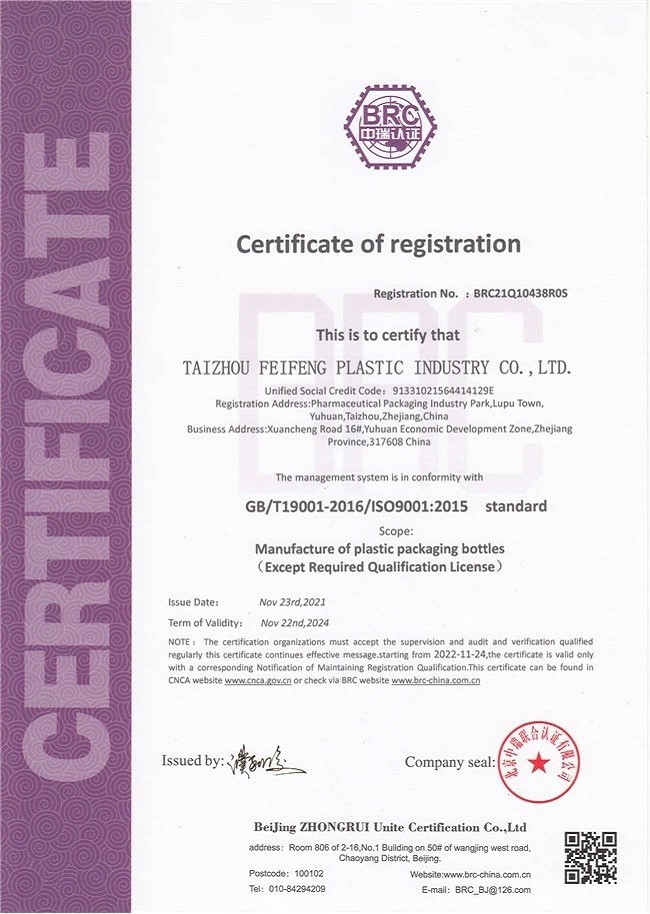
Our company has iso9001, food plastic packaging production license, other certificates are in the process of application, to give you a safe and assured product, welcome to consult and understand.
Pharmaceutical Market: In the pharmaceutical industry, plastic medicine bottles are widely used to package various medicines, such as pills, capsules, granules, and liquid medications. As a crucial component of drug packaging, plastic medicine bottles effectively protect the quality and safety of medicines, preventing moisture, oxidation, and contamination, thus ensuring stability and efficacy. Additionally, plastic medicine bottles offer cost-effectiveness and convenience, meeting the pharmaceutical companies’ demands for large-scale drug packaging, thereby enhancing production efficiency and sales speed.
Health Supplement Market: Plastic medicine bottles also find extensive application in the health supplement market. Health supplements include various nutritional supplements, natural herbal products, vitamins, and minerals, all requiring reliable packaging to preserve their quality and constituents. Due to their durability, lightweight, and cost-effectiveness, plastic medicine bottles are ideal for health supplement manufacturers. These bottles effectively safeguard health supplements from moisture, oxidation, and external contamination, maintaining their active ingredients and efficacy while remaining portable and convenient for consumers.
Veterinary Medicine Market: Similarly, plastic medicine bottles play a significant role in the veterinary medicine sector. Veterinary medicines encompass drugs for livestock and pets, necessitating secure and reliable packaging to ensure animal well-being. Plastic medicine bottles meet the packaging needs of veterinary medication, providing excellent sealing and moisture resistance to protect them from dampness and contamination, thereby ensuring their effectiveness and therapeutic benefits. Manufacturers and veterinary institutions often require a large quantity of veterinary medicine packaging, and the wholesale supply of plastic medicine bottles meets this demand, promoting the steady development of the veterinary medicine market.
Materials Used in Plastic Capsule Bottle


High Density Polyethylene (HDPE)
HDPE is a thermoplastic polymer that is traditionally made from oil or natural gas. HDPE is one of the most versatile plastics and is used in a variety of applications, like plastic beverage bottles, plastic piping, and of course, plastic bottles for packaging pharmaceutical, nutraceutical, and lifestyle products. HDPE resin is translucent in its natural state; colorants are added during the bottle manufacturing process to change the color.
Low Density Polyethylene (LDPE)
Like traditional HDPE, LDPE is also made from oil and natural gas. Any product that needs to be dispensed by squeezing the bottle is a good candidate for LDPE. Products like lotions, gels, and ophthalmic solutions work well inside LDPE bottles. Although there is very little difference in density between HDPE and LDPE, LDPE has considerably less strength when compared to HDPE.
Polyethylene Terephthalate (PET)
PET is part of the polyester family, and is known as the most common thermoplastic polymer resin. PET is commonly used to package liquid dose medications, like cough syrup, as well as vitamins and supplements. It is also a popular choice for lifestyle products in large part because PET can be made in a variety of colors while maintaining its transparent appearance.
Polypropylene (PP)
Polypropylene is a type of plastic that is known for its semi-crystalline nature. It is a great choice for solid dose prescription and over-the-counter medications, creams and ointments, and powdered supplements. We use PP to manufacture our closures as well.
How To Choose The Size Of Medicine Bottles
Dosage Requirements: Consider the dosage requirements of the medication. Choose a bottle size that can accommodate the prescribed amount of medicine without leaving excess space.
Shelf-life And Storage: Check the shelf-life of the medication and the storage instructions provided by the manufacturer. Consider a bottle size that can be stored appropriately without compromising the quality or potency of the medication.
Frequency Of Use: Consider how often the medication will be used. If the medicine is used frequently, opt for a larger container to avoid the need for frequent refills.
Portability: If the medication needs to be carried or transported frequently, opt for a smaller, portable size that can fit in a purse or bag.
Accessibility: Consider the age, mobility, and dexterity of the person who will be using the medicine. Choose a size and style that are easy to open and use, particularly for those with arthritis or other mobility issues.
Cost: Choose a size that balances the prescription requirements and budget. Larger containers may be more cost-effective, but they may also result in waste.
Importance Of Air Tightness Testing Of Plastic Capsule Bottle
The air-tightness of the plastic bottle is very important to prevent the medicine from being damp and deteriorating during the validity period. It is also an important medium to prevent the influence of light, heat, oxygen, etc. On the medicine. Therefore, as a pharmaceutical plastic bottle manufacturer, we attach great importance to its air tightness testing. What is the air tightness of medical plastic bottles? Simply speaking, it is tested according to relevant national standards. For example, the reliability of the sealing of plastic capsule bottles is tested by taking a certain number of plastic capsule bottles, filling an appropriate amount of glass balls in each bottle, and tightening the cap. Then put it into a container with an air extraction device, immerse it in water, evacuate to a vacuum of 27kpa, and maintain it for 2 minutes. There should be no water or bubbles in the bottle. Of course, to ensure the air-tightness of the plastic bottle capsule through the index, some other economic indicators, such as resistance, moisture resistance and oxygen control, are needed to ensure the quality of the shelf life product.
There are also machines on the market that have introduced a sealing tester. Using the principle chamber vacuum of a vacuum cleaner, the pressure difference between the internal and external pressures of the medicinal plastic bottle submerged in water is produced, and the gas escape inside the sample is observed to determine the sealing performance. : Or through the vacuum chamber, make the sample production internal and external pressure difference, observe the inflation of the sample and the recovery of the sample shape after releasing the vacuum, in order to determine the sealing performance.
Plastic Capsule Bottle Neck Finish And Thread Styles
Common bottle neck finish
Common sizes of plastic medicine bottle necks include 28mm, 33mm, 38mm, 45mm, and 53mm. The 28mm neck is frequently used for plastic containers of oral syrups and liquid medications. The 53mm neck is commonly employed for large-sized containers of pharmaceutical products.
Common thread styles
This common thread type can be identified by the threads that wrap around the neck of the container continuously without any breaks in the thread.
400 Neck finish indicates one thread turn.
410 Neck finish indicates one and a half turns.
415 Neck finish indicates two thread turns, but the threads are thinner and the neck is typically taller.
425 Neck finish indicates two thread turns but is most commonly found on smaller-capacity containers such as vials.Ish indicates two thread turns, but the threads are thinner and the neck is typically taller.
430 Neck finish indicates one or two thread turns. The threads are deeper than the uniform standard 400 and 415 neck finish. This unique neck shape is known as a buttress and is designed to help the user pour product with better accuracy.
How To Properly Store Empty Plastic Capsule Bottle For Pharmaceutical
Proper storage of plastic bottles ensures their quality, safety, and extends their lifespan. Here are the storage methods for plastic bottles:
Clean And Dry: Before storage, ensure that the plastic bottles are clean and free from any dirt or residue. Use a mild detergent and clean water for washing, then thoroughly air-dry them.
Avoid Direct Sunlight: Store plastic bottles in a place where they are protected from direct sunlight. Ultraviolet rays in sunlight can degrade plastic, affecting its quality and durability.
Avoid High-temperature Environments: Plastic bottles should not be exposed to high temperatures to prevent deformation or softening of the plastic, which may impact its sealing and stability.
Avoid Extreme Temperature Changes: Avoid rapid temperature changes as they can cause stress in the plastic bottles, affecting their performance and lifespan. Store the bottles in a relatively stable temperature environment whenever possible.
Keep Away From Chemicals: Plastic bottles should not come into contact with chemicals or other harmful substances to prevent corrosion or contamination of the plastic.
Labeling: When storing plastic bottles, labeling or marking them can help identify and distinguish different types of medications or chemicals.
Neat Stacking: Plastic bottles should be stacked vertically, avoiding overlapping or tilting to ensure stability and sealing.
Keep Dry: Try to avoid leaving plastic bottles exposed to a damp environment for extended periods to preserve their performance and moisture resistance.
Are Plastic Capsule Bottle Safe for Drugs
Plastic medicine bottles are safe, but it is crucial to use safe plastic materials and adhere to relevant standards during the manufacturing process.
Material Selection: Choose medical-grade plastic materials that comply with legal regulations, such as pet, hdpe, and pp. These plastics are widely recognized as safe packaging materials and can be used for food and drug contact.
Production And Processing: The production process of plastic medicine bottles should comply with gmp standards to avoid contamination and impurities. The hygiene status of production processes and equipment is essential to ensure the safety of the bottles.
Sealing Capability: Plastic medicine bottles should have good sealing properties to prevent drugs from being affected by moisture, oxidation, and contamination. Proper sealing prevents drug leakage and contamination risks.
Pigments And Additives: Use safe pigments and additives to adjust the color and performance of plastic medicine bottles, ensuring they do not release harmful substances.
Quality Control: Pharmaceutical companies and packaging suppliers should implement strict quality control measures to ensure the quality and safety of plastic medicine bottles.
Storage And Use: The storage and use of drugs in plastic medicine bottles should adhere to pharmaceutical production and storage standards. Drugs should not exceed their labeled shelf life and should be stored under appropriate temperature and humidity conditions.
Certifications